

Which Projects Actually Need Helical Piles? A Foundation Decision Guide


It's the middle of build season in Utah and Wyoming, and if you're planning a project right now, you've probably hit the same question every homeowner and contractor eventually asks: does this thing need a real foundation and if so, what kind?
Helical piles (also called screw piles or helical piers) aren't the answer for everything. But for a surprising number of projects, they're the faster, cleaner, and more reliable answer than pouring concrete. This foundation decision guide walks through when helical piles make sense, when they're overkill, and how to decide for your specific project.
Here's a Quick Test To Determine If Helical Piles are Needed: Three Questions, Foundation Decision Guide
Before we get into project types, run your project through these three questions.
1. Does the structure need to stay put through freeze-thaw cycles?
Utah and Wyoming soil moves. Frost heave lifts and drops anything sitting in the frost zone, which is exactly where shallow concrete footings live. Helical piles are driven below the frost line into load-bearing soil, so seasonal ground movement doesn't touch them. If your structure attaches to your house (a deck, an addition, a sunroom), movement isn't just annoying, it's structural damage waiting to happen.
2. Is speed or site access a factor?
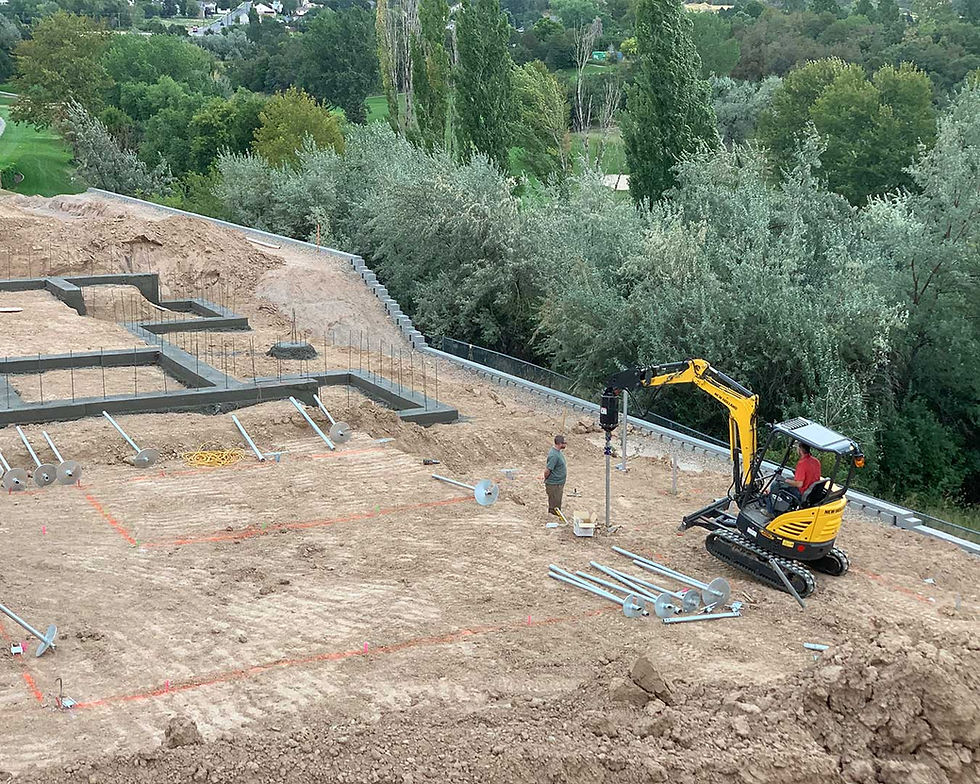
Helical piles require minimal excavation and no concrete curing. Most decks are installed in a single day, and you can build on the piles immediately. If your project timeline is tight, your yard is landscaped, or heavy excavation equipment can't reach the site, screw piles solve all three problems at once.
3. Does the load need to be verified?
Every helical pile is installed with torque monitoring that correlates directly to load capacity, meaning the capacity of your foundation is verified during installation, not assumed. Concrete footings can't offer that. For engineered projects, permitted structures, and anything a building inspector will look at, that's a meaningful difference.
If you answered yes to any of these, helical piles belong on your shortlist. Now let's get specific.
Residential Projects: Where Helical Piles Win
Decks, gazebos, and pergolas. This is the classic use case, and for good reason. A deck on helical piles skips the dig, skips the concrete wait, and goes up in a fraction of the time. Deck builders across the Wasatch Front have moved to screw piles almost entirely because they can install footings in the morning and frame in the afternoon.
Home additions and sunrooms. Additions are where frost heave does the most expensive damage, because the new structure ties into your existing home. Helical piles put the addition on the same stable footing, literally, without excavating next to your foundation or tearing up the yard between.
Sheds, garages, and carports. For sheds and garages, the decision usually comes down to slab versus piles. If the building sits on a slope, on poor soil, or anywhere excavation is a headache, piles win. They're also the only practical option for moving or leveling an existing outbuilding.
Pools, fences, and everything else in the yard. Above-ground and semi-inground pools, fence lines, mailbox posts, exterior stairs, anything that needs to resist movement benefits from a foundation anchored below frost depth.
Commercial, Agricultural, and Municipal Projects
The same physics that keep a deck level keep a warehouse level. On the commercial side, helical piles carry serious structural loads while eliminating the excavation, spoil removal, and cure schedules that drag out concrete timelines.
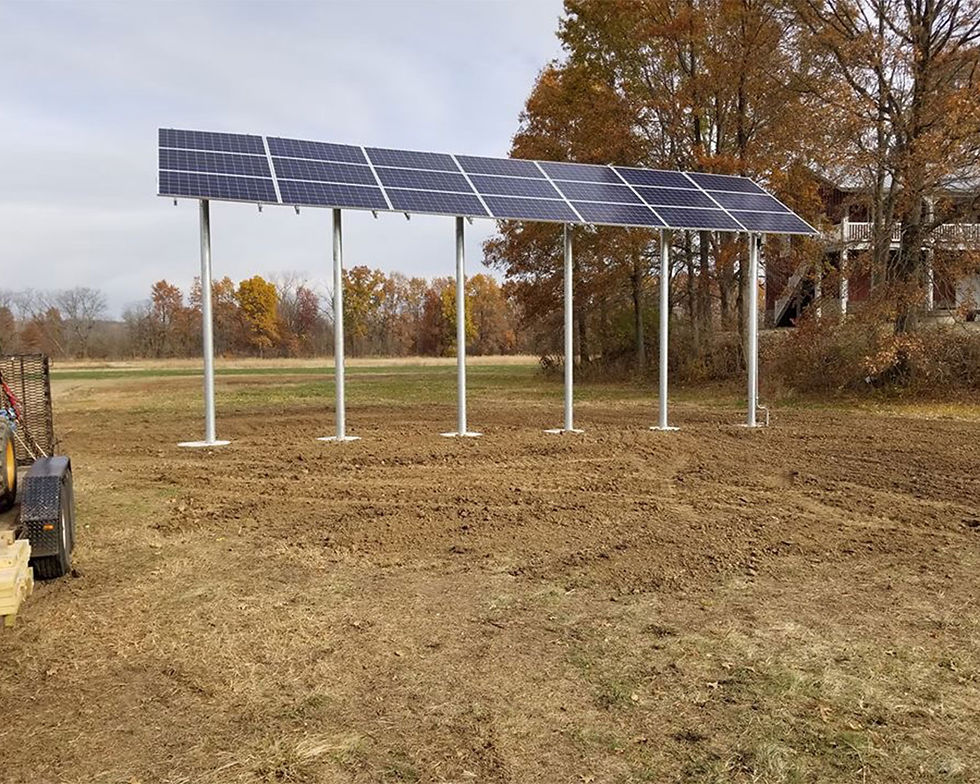
Common commercial applications include warehouses and steel buildings, solar panel arrays, EV charging stations, cell towers, signage and billboards, boardwalks, parks and playground equipment, and agricultural structures like silos, greenhouses, and ag tents. For remote sites, a solar farm outside Casper, a boardwalk in a wetland, a cabin off-grid in the Uintas, the fact that piles install with compact equipment and zero concrete deliveries is often the deciding factor by itself.
When Helical Piles Are Probably Overkill
Honesty matters here. If you're building a small ground-level platform that isn't attached to a structure, doesn't carry meaningful load, and won't be damaged by a little seasonal movement, deck blocks or a gravel base may be all you need. Likewise, a full slab-on-grade building in ideal soil conditions with easy site access is a case where conventional concrete can be competitive.
The gray zone, and the place where a quick conversation with an installer pays off, is anything attached to your home, anything on questionable soil, anything on a slope, and anything you want done fast.
What Verification Actually Looks Like
One more factor worth understanding: certified installation. GoliathTech piles are ICC-ES certified and installed by trained, certified installers using torque-monitored equipment. Each pile is driven until it reaches the torque reading that corresponds to the engineered load requirement for your project. The result is a foundation with verified capacity and a 30-year warranty on the piles, backing that concrete simply doesn't come with.
If you want to go deeper on how the system works, our complete guide to helical piles covers the engineering, and our screw piles vs. concrete footings comparison breaks down cost, speed, and lifespan side by side.
Frequently Asked Questions: When to Use Helical Piles
How do I know if my project needs helical piles or just deck blocks?
If the structure attaches to your home, carries real load, or needs to stay level through freeze-thaw cycles, it needs a foundation anchored below the frost line — that's helical piles. Deck blocks are only appropriate for small, free-standing, ground-level platforms where some seasonal movement is acceptable.
Are helical piles worth it for a small shed?
Usually yes, if the shed sits on a slope, on soft or clay-heavy soil, or anywhere a level slab would require excavation. For a small shed on flat, stable ground, a gravel base can be sufficient — the deciding factors are soil, slope, and how much you care about the doors still closing in five years.
Can helical piles support projects attached to my house, like additions?
Yes — attached structures are actually where helical piles matter most. An addition or attached deck on shallow footings moves differently than the house it's tied to, which cracks connections over time. Piles driven below frost depth keep the new structure as stable as the existing foundation.
Do helical piles work in all Utah and Wyoming soil types?
They perform reliably across the region's range, sandy benchland, valley clay, and rocky mountain soils. Each pile is installed to a torque reading matched to your project's load requirement, so depth and configuration adjust to your site's actual conditions rather than a one-size assumption.
How much do helical piles cost compared to concrete footings?
Per-footing pricing is often comparable once you account for excavation, spoil removal, concrete delivery, and cure time that concrete requires. On sites with difficult access, slopes, or winter timelines, piles are frequently the cheaper total option.
Request a quote for numbers specific to your project.
Get a Project-Specific Answer
Every list like this has a limit: your soil, your slope, your structure, and your timeline are specific to you. The fastest way to know whether helical piles fit your project is to ask, quotes are free, and most residential projects can be assessed from a few details and photos.
Get a free quote and we'll tell you straight whether helical piles are the right call for your project, anywhere in Utah or Wyoming.

Comments