

Case Study: What a Helical Pile Deck Foundation Actually Saves You


We know that deck builders and homeowners hear the pitch, no digging, no curing, done in a day, but showing the numbers is more convincing than statements. This case study walks through a typical mid-size residential helical pile deck foundation project in Utah and compares what the foundation phase looks like with concrete footings versus GoliathTech Utah helical piles, using standard install parameters for a project of this size.
The figures below are estimates based on typical helical pile deck installations of this scope, a representative project profile, not measurements from one specific job site. They're useful for understanding the order of magnitude of the time and disruption difference, not as a quote for your specific project. Request a quote for numbers specific to your project.
The Project Profile
To make the comparison concrete (no pun intended), this case study uses a common deck scenario along the Wasatch Front:
Deck size: ~300 sq. ft. attached residential deck
Estimated pile/footing count: 8–10 support points
Soil conditions: typical Utah valley soil, moderate frost depth
Season: late fall, a point where concrete crews often start losing days to weather
Foundation Method 1: Poured Concrete Deck Footings
A concrete footing installation for a deck this size typically runs through the following phases:
Layout and hand-digging or auguring 8–10 footing holes below frost line, about 1 day
Set sono tubes, place deck post brackets and puring concrete 1 day
Minimum cure time before load-bearing framing can begin, 2–3 days, longer in cold weather
Estimated total time to framing-ready: 4–5 days
Weather adds risk on top of that baseline. A rained-out pour, an early freeze, or a delayed concrete delivery can each push the timeline out further, and once the ground starts freezing in earnest, pouring footings at all becomes difficult without additional cost for ground thawing or heated enclosures.
Foundation Method 2: GoliathTech Helical Piles Deck Foundation
The same 8–10 support points, installed as helical piles instead:
Site layout and pile placement, 1–2 hours
Mechanical installation of piles to engineered torque and depth as well as placing deck post brackets, 3–5 hours.
Cure/wait time before framing, none, piles carry load immediately
Estimated total time to framing-ready: same day
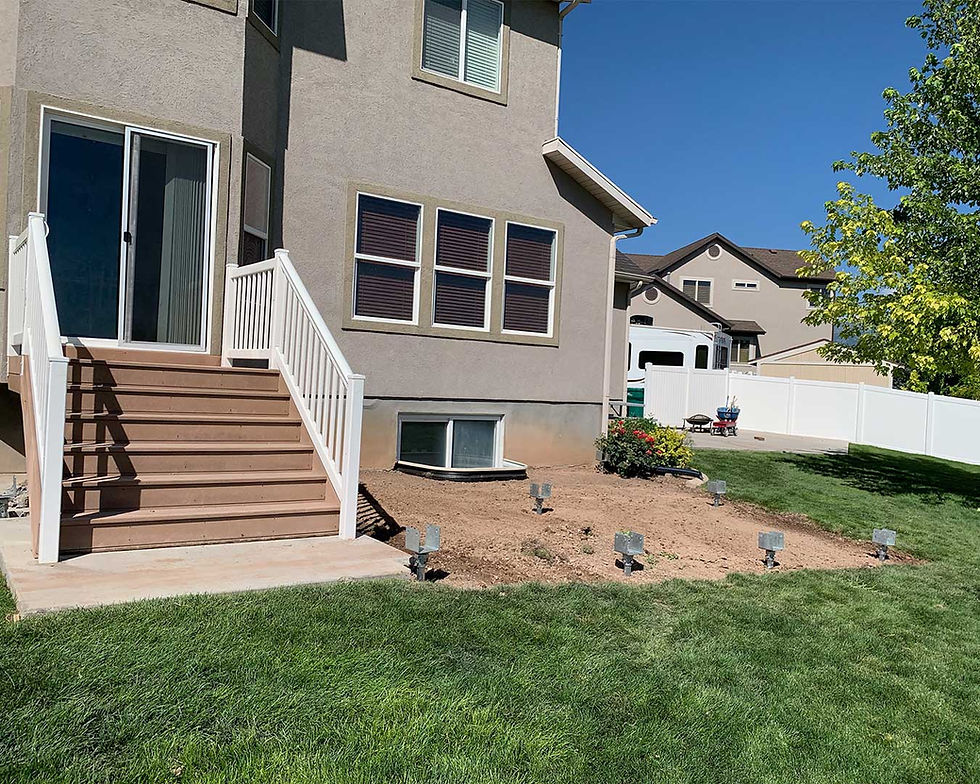
Because piles are mechanically screwed to a calculated torque rather than poured and cured, there's no waiting period between foundation and framing. A crew can install
piles in the morning and start framing that afternoon.
Side-by-Side Comparison (Estimated)
Time to framing-ready, Concrete footings: 4–5 days | Helical piles: same day
Excavation / spoil removal, Concrete footings: yes | Helical piles: none
Weather dependency, Concrete footings: high (cure time, freeze risk) | Helical piles: low (installs in frozen ground)
Site disruption, Concrete footings: dug holes, concrete truck access, cure-time fencing/staging | Helical piles: minimal, equipment footprint only
Engineering basis, Concrete footings: standard footing sizing | Helical piles: torque-verified to engineered load
Warranty, Concrete footings: varies by installer | Helical piles: 30-year warranty on GoliathTech piles
Again, these are typical, estimated figures for a project of this scope, not a guarantee for any specific site. Actual pile count, spacing, and install time depend on soil conditions, load requirements, and site access, all confirmed during a GoliathTech Utah site
assessment.

Why the Time Savings Matters
For a homeowner, cutting 4–5 days down to a single day means less time with an unfinished yard, less coordination around weather windows, and a faster path to actually using the deck. For a contractor or builder running multiple projects through a season, that same time savings compounds, fewer stalled job sites waiting on concrete cure, more projects turned over per crew per month, and far less schedule risk tied to weather.
This is the same logic that applies across other helical pile applications beyond decks, home additions, garages, retaining walls, and more all benefit from removing excavation and cure time from the schedule.

When Concrete Still Makes Sense
Helical piles aren't the right fit for every project. Very large structures, certain soil conditions, or specific engineering requirements may call for a different foundation approach. A site assessment is the best way to confirm which method fits your project, see our full breakdown on screw piles vs. concrete footings for a more general comparison.
Get Project-Specific Numbers
Estimates are useful for planning, but every site is different. GoliathTech Utah installs helical piles for decks and other residential, contractor, and commercial projects across Salt Lake City, Ogden, Provo, and the Wasatch Front, as well as Wyoming markets.
Learn more on our helical piles for decks page, or request a free quote to get a timeline and cost estimate specific to your project.


Comments